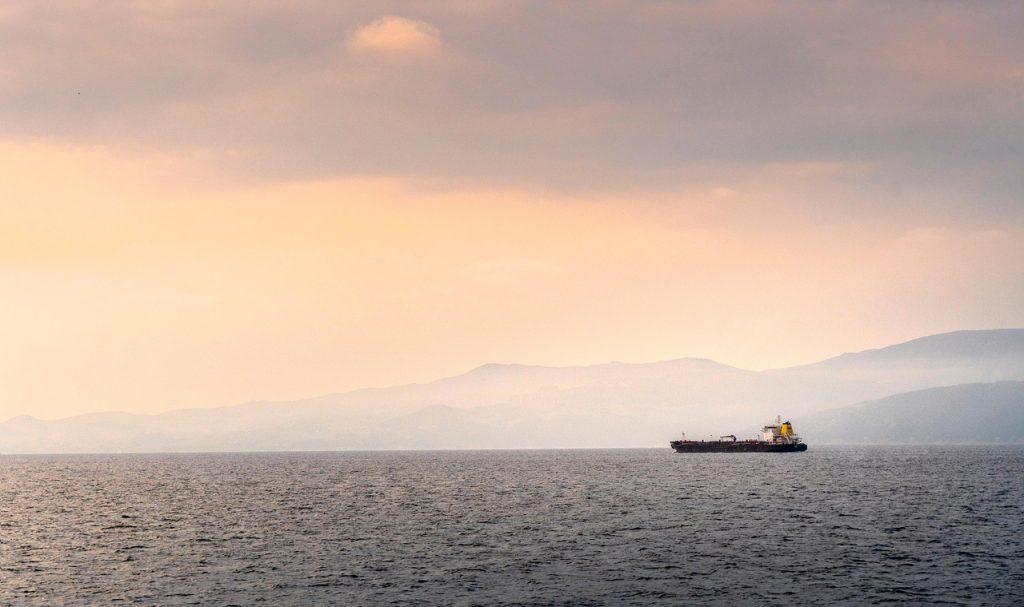
The Persian Gulf is bordered on both sides by countries that export about 25% of the worlds crude oil and 20% of the world’s liquified natural gas (LNG). What’s more, the two sides don’t always get along with each other: Iran is about 95% Shia Muslim and the Arabian countries (except for Bahrain and Iraq) are predominantly Suni. There has been a long litany of problems throughout modern history that relate to the control and management of this waterway. To begin with, let’s take a look at the Strait of Hormuz itself and the laws of the sea that apply.
The Strait Itself: The Strait of Hormuz connects the Persian Gulf with the Arabian Sea and the Indian Ocean, and is the only navigable waterway in or out of the Gulf. It’s about 104 miles in length and the width varies from sixty miles at the widest to twenty-four miles at the narrowest points. On the eastern side of the Strait and the entire Persian Gulf lies the Islamic Republic of Iran. On the western side lies the Arabian Peninsula and the countries of Oman, Bahrain, United Arab Emirates (UAE), Qatar, Saudi Arabia, Kuwait and Iraq (among others). Virtually all the countries surrounding the Gulf export and/or process for export petroleum and petroleum products. The passageway through the narrowest parts of the Strait is set up in lanes very much like a freeway with buffer space in between the eastbound side and the westbound side.
International Law Concerning Right to Passage: The rights to free passage to the world’s waterways have been defined by an what’s known as the United Nations Convention on the Law of the Sea Treaty (UNCLOS). This convention was established in December, 1982, and as of October, 2024, 169 nations have ratified it. Ironically, the United States has not yet ratified it and neither has Iran. Going back to the 17th century the law of the seas confined a nation to a territorial limit of about three miles from its shores. Known as the “cannon shot” rule, it meant that all waters that extended beyond the limit were free to everyone but belonged to no one particular country. This limit began to change in the 20th century as a number of nations desired to expand their range to protect fishing and other ocean resources near their shores. UNCLOS generally permits the territorial distance to be extended to twelve miles, but also has codified a right to passage through certain areas that are technically territorial. Most countries including the U.S. claim this right to passage through the Strait of Hormuz even though passing through could include crossing Iranian or Omani territorial waters.
Events That Have Occurred Concerning Right to Passage:
1. Portugal Seizes Control Over the Strait in 1507.
After Portuguese explorers discovered the Persian Gulf while enroute to India, Portugal decided to set up a fortified customs installation on the small island of Hormuz to collect a tax from any other ships that were attempting to pass through the Strait of Hormuz into the Persian Gulf. This arrangement worked well for Portugal for over a century until the British East India Company joined up with Shah, Abbas I in 1622 to drive them out. The British received lucrative trading rights for their participation, but no tolls were charged any other vessels that passed through the Strait.
2. British Navy Blockades the Strait in 1951.
In 1908, oil was first discovered in Iran by British explorers, and a large industry soon developed using British technologies. The British took a large amount of the profits, however, and that pushed Iranian Prime Minister, Mohammad Mossadegh, to nationalized the petroleum industry in 1951. The British reacted by sending their large ocean navy down to blockade Iranian shipping near the port of Abadan in the northern part of the Persian Gulf. Two years after the Shah had fled, the British and the American CIA, supported a coup that drove out Mossadegh and returned the Shah who re-established the statis quo for the Western oil companies.
3. The Tanker War of 1984.
During the Iran-Iraq War in the 1980’s Sadam Hussein attacked some Iranian oil tankers with the likely intent to force an over-reaction by Iran that would close the Strait and bring in U.S. assistance to reopen it. However, Iran did not take the bait, did not close the Strait of Hormuz, and delivered only measured responses to Iraqi shipping.
4. Operation Praying Mantis in 1988.
Iran decided to mine portions of the Persian Gulf in the later stages of the Iran-Iraq War and this caused damage to a U.S. Navy warship that was escorting neutral countries’ tankers through the Gulf. In retaliation for the hit on the USS Samuel B. Roberts, the U.S. Armed Forces launched Operation Praying Mantis on April 18. 1988. U.S. naval and naval air forces led the attack that severely damaged or destroyed most of the Iranian Navy’s surface craft that consisted primarily of speed boats capable of moving in and around neutral countries’ tankers. But it took nearly to the end of 1988 to remove all the danger from mines in the Gulf.
5. Downing of an Iranian Passenger Airliner in 1988.
On July 3, 1988, the U.S. Navy cruiser Vincennes accidentally shot down Iran Air Flight 655 while the airliner was passing over the Persian Gulf killing all 290 persons on board. The accident occurred despite repeated warnings issued by the ship’s radio communication officer that the airplane had entered restricted airspace. The radio warnings were confirmed by an Italian tanker that was nearby, but not acknowledged by the flight crew of Flight 655. In 1996, a settlement was reached in which the U.S. would compensate the families of the victims without any admission of guilt or legal responsibility.
6. Revolutionary Guard boats stop the Maersk Tigris, 2015.
On April 28, 2015, Iranian gunboats accosted the container ship Maersk Tigris in the Strait and ordered it to proceed to Iranian waters in the Gulf. The ship’s captain refused to comply, but then changed his mind after one of the boats fired shots across the ship’s bridge. The U.S. Navy monitored the situation closely, but as it turned out, the issue was over a dispute concerning ten container boxes that were shipped by the line to Dubai ten years earlier. Maersk agreed to pay a fine to settle the dispute.
7. Revolutionary Guard boats stop the Hankuk Chemi 2021.
On January 4, 2021, the South Korea-flagged tanker, Hankuk Chemi, was seized by Iranian authorities for causing oil pollution in the Strait of Hormuz. The ship had acquired a load of crude from Jubail, Saudi Arabia, and was bound for the port of Fujairah in the United Arab Emirates.
8. Iranian Navy ship problems, 2021.
The Iranian Navy had some problems of its own to cope with in the Gulf. In May, 2020, the Iranian Military launched some missiles at one of their own vessels that would up killing 19 sailors in a friendly fire accident. Over a year later, the Iranian Navy’s replenishment oiler, the IRIS Kharg, caught fire and sank in the Gulf of Oman near the Strait of Hormuz. There were no more than thirty casualties and no fatalities as all the crew were successfully evacuated. The ship went down in shallow waters and still rests there.
9. Iranian Navy seizes MSC Aires, 2024.
In April, 2024, the Iranian Navy seized the Portuguese-flagged container ship, MSC Aries in the Gulf of Oman, outside of the Strait of Hormuz. Claiming that it had violated international maritime law, they then steered the ship through the strait to Iranian waters. After intense diplomatic pressure, the twenty-five crew members were released, but the ship is still in Iranian custody despite strong diplomatic efforts to gain its release by the U.S., U.K., and Portugal among other countries.
10. Iranian Preparations to mine the Strait, 2025.
In June, 2025, reports from U.S. Intelligence indicated that the Iranian Military had loaded supplies of naval mines onto vessels inside the Persian Gulf. The source of the intelligence was not disclosed, but may have included either satellite imagery, or informants. This appeared to foreshadow the mining of the Strait, but the mines were never deployed. However, no further evidence was released to indicate that the mines were ever removed from the ships and returned to storage.
11. Naval Standoffs, from 2008 to Present.
Several naval standoffs between the U.S. Navy and Iranian naval forces in the Persian Gulf occurred from December, 2007 to January, 2008. The U.S. Navy, accused Iran of harassing and attempting to provoke U.S. Navy ships into armed conflict. However, the U.S. Navy’s Regional Commander, Vice Admiral Kevin Cosgriff, noted that the Iranian ships, primarily speed boats, were armed with “neither anti-ship missiles, nor torpedoes” and therefore posed no credible threat to U.S. ships.
12. Iran Threatens to Close the Strait, 2008-2019.
On numerous occasions from 2008-2019, Iran threatened to close the Strait of Hormuz over one incident or another, but particularly after the application of sanctions on Iran by the U.S. and its allies. The war of words and threats to close the Strait continued during the period from December 27, 2011, to January 3, 2012. These threats were met by reinforcements by the U.S. Navy and allied navies as over forty warships, including three U.S. aircraft carriers, left home waters to assemble inside the Persian Gulf. Later in 2019, the Norwegian tanker, Front Altair, and the Japanese tanker Kokuka Courageous, were shook by explosions that appeared to be the result of missile strikes. Neither ship sank, but the crews of both ships evacuated and were rescued by Iranian and U.S. Navy ships. In July, 2019, the British bulk tanker Stena Impero was seized and boarded by Iranian forces in retaliation for the British seizure of an Iranian tanker near the Straits of Gibraltar in the Mediterranean.
The Iran War of 2026: In June, 2025, Iran made yet another threat to close the Strait after an Israeli attack on military and nuclear storage targets. On June 22, 2025, the U.S. Navy and Air Force also attacked Iranian nuclear storage locations prompting the Iranian Parliament to vote to close the Strait. The final call, however, must come from the Supreme National Security Council in Iran who decided not to close the Strait at that particular time, but reserved the right to do it to protect their sovereignty whenever necessary. On February 28, 2026, both Israeli and U.S. Military Forces launched a series of attacks in an effort to destroy Iranian nuclear weapon facilities and destabilize the Islamic regime by weakening their military capacity. The Iranian Republican Guard began issuing radio transmissions stating that ship’s passage through the Strait would no longer be allowed. The number of ships transiting the Strait prior to the closing amounted to 100-140 per day (both directions), about half of which were oil or LNG carriers. Since the closing, that total has dropped to a trickle of only a handful or so. The international community is deeply concerned about the events as the sharp rise in the price of oil threatens to cause a worldwide recession.
Conclusions: Since the onset of the Iranian Islamic Revolution in1979, Iran has claimed full control over the Strait of Hormuz. Owing to the conflict that is taking place primarily on land, the risks of shipping through the Strait have skyrocketed into higher crude oil prices, but also higher shipping costs and marine insurance. Several ships from neutral countries and other Gulf exporters have been struct by drones or missiles with damage and fires resulting. As of this writing a two-week ceasefire has been agreed to by both Iran and the U.S. to enable negotiations to take place to settle the issues. It is not clear if a settlement will be reachable in two weeks, but at least a start appears to have been made.
Sources: History.com, The Strait of Hormuz: A Timeline of Tensions, by Dave Roos, March 13, 2026.
Wikipedia, Strait of Hormuz.
ChatGPT.