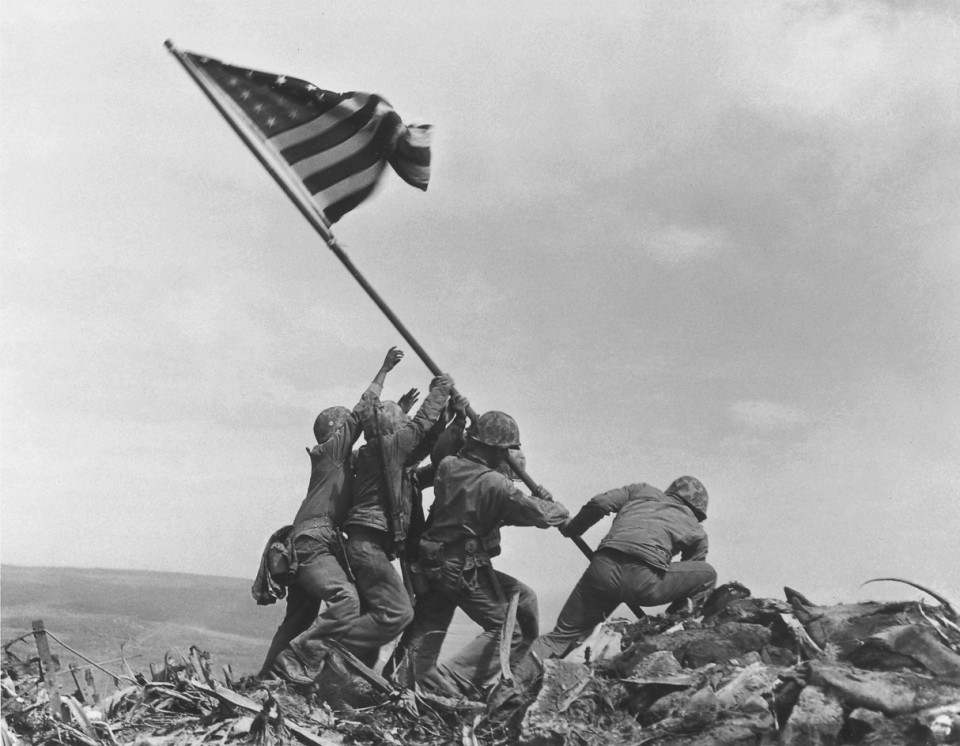
Late in World War II in the Pacific an Associated Press photographer happened into capturing a photograph that became famous world-wide. The story of the picture is interesting by itself, but it includes a major shift in battle tactics used by the Japanese Military in their defense of Iwo Jima, one of the bloodiest battles the Marines faced during the entire war. Here’s the story behind it all.
The War in the Pacific Background: World War II in the Pacific had entered its third year by February, 1945. Owing to the logistics, the progress had been slow and difficult as U.S. forces engaged Japanese forces in different island locations across the Pacific Ocean. The decision to invade Iwo Jima, about 760 miles south of Tokyo, was itself shrouded by controversy as a number of military minds pointed out that the island was strategically useless—the Army Air Force was able to strike Japan from other islands, and the plan ignored a nearby island that provided Japan with early warning radar. However, the Island did have two airfields, and U.S. long range fighter planes would be able to escort the heavy bombers on their way to bomb Japan’s home islands. The attacking force would be largely unopposed at sea as the island was out of the range of land based Japanese planes, and the Japanese Imperial Navy lacked the capacity to interdict any U.S. invasion by sea. The steps to take the well-defended island could further provide insight for the upcoming Okinawa Campaign and the eventual invasion of Japan, thought to be necessary by most American military planners at the time.
Japanese Defenses on Iwo Jima: In June, 1944, command of the Japanese forces defending Iwo Jima went to Lieutenant General Tadamichi Kuribayashi, who viewed his mission with the belief that he would never defeat the U.S. forces, but instead might manage to make them incur heavy losses that would change their plans to invade the Japanese homeland. His strategy broke with convention as he moved the main line of defenses away from the beaches to a complex system of fighting positions that in many cases were linked by tunnels. Other measures included camouflaging tanks and using them as stationary artillery, hiding machine gun nests, and placing heavy artillery behind steel doors. The extensive tunneling enabled the Japanese to reoccupy a fighting position such as a pillbox that had previously been evacuated. In addition to aiding troop movement, the tunnel system included barracks and command centers all protected from bombing and artillery shelling. This meant that Kuribayashi was more interested in fighting a protracted engagement, rather than meeting his enemy head on. By the time the invasion began, the system of defensive tunnelling reached for eleven miles, but ironically it did not connect with Mount Suribachi which had its own separate tunnel system.
Preparatory U.S. Naval bombardments: The preparatory naval artillery shelling and aerial bombardments of Iwo Jima began in June, 1944, over eight months before the actual invasion began. This strategic effort was not constant, but took place many times searching out and destroying those targets believed to be important to the Japanese defense. But the planners and strategists were not aware of the growing tunnel system, and likely assumed that the attacks had been effective when reconnaissance showed that the targets were no longer visible. When the U.S. Navy Amphibius force arrived in February, 1945, the artillery bombardment was continued in earnest for three days prior to the landing. The weather hampered the effort and particularly the reconnaissance, and there were a few surprises when it came time to land the troops. When the heavy cruiser USS Pensacola came within range of the shore batteries, it was promptly hit six times by Japanese artillery and had to retreat back out to sea with seventeen dead sailors. The destroyer USS Leutze likewise was hit and incurred a loss of seven crewmen. Though intense, the bombardment was less effective than anticipated, and another day of bad weather limited the naval gunners’ effectiveness again the day before the landing.
Isolating Mount Suribachi: On the morning of the day the landing took place, the Marines were able to reach the undefended beaches fairly easily, but after an hour or two when the beaches were the most crowded, the Japanese opened fire from their concealed positions. Further, the earth in the area was covered with volcanic ash inhibiting the movement of vehicles and requiring the Marines to advance on foot. The death toll was increased as the follow-up landing waves came onto the highly crowded beaches. Finally, a construction battalion offloaded some heavy road paving equipment that smoothed out some avenues off the beach on the land side, and the Marines were able to push forward. A detachment made it to an airfield completing one major objective for the first day, but another important objective was also achieved and that was a large detachment of Marines pushing completely across the island at its narrowest point, thereby isolating Mount Suribachi on the south end from the main force of defenders who were on the north end.
Taking Mount Suribachi and Raising the Flag: Being aware of a defensive tunnel system on Mount Suribachi, the Marine commander of the force that was assigned to take the volcano was concerned that major fighting lay ahead. He sent two patrols up to scout out the enemy’s positions, and then with that information he sent a larger patrol up to take the summit. But the larger patrol encountered only a few pockets of resistance as the majority of Japanese troops were inside their tunnel protection during the pre-invasion bombardment or already dead. The patrol’s commander took the battalion’s American flag with him to raise it on the volcano’s summit to identify to the fleet that the Marines had reached the top. Connected to a piece of water pipe found in the wreckage of the shelling, the flag went up, and was photographed by a Marine photographer that accompanied the patrol. At that same moment, James Forrestal, Secretary of the Navy who had just landed on a beach, decided he wanted the flag as a souvenir. A much larger flag sent up by a runner to the summit, was then attached to a longer piece of pipe and raised in the first flag’s place.
Joe Rosenthal and the Famous Picture: An Associated Press photographer named Joe Rosenthal was at the base of Mount Suribachi at the time it was captured. He began to climb up towards the summit to try to photograph the flag raising, but he encountered the original Marine photographer who explained that the flag raising had already taken place. Deciding that other good pictures might still be obtainable, he continued up to the summit only to discover the second flag raising about to begin. He carefully prepared a spot to stand on that offered the best view and light for the picture. When he observed the Marines inserting the makeshift pole into the ground and raising the flag, he captured a very special photograph. He did not know it at the time—the film had to be packed off to Guam to be processed, but his bosses and execs at the Associated Press knew how great a picture it was and distributed it on the front page of the world’s great newspapers and magazines. It was sometime later that Rosenthal could see the results of what he had accomplished.
The Picture’s Importance: Although naysayers asserted that the event had been staged, the Marines also had another photographer up at the summit who recorded the same event with motion picture camera confirming its authenticity. Rosenthal went on to win the Pulitzer Prize for news photography, and hold the distinction for having won the prize in the same year the photo was taken. The picture was also used as the blueprint for a large statue placed at the Marine Corps War Memorial in Arlington, Virgina. The picture’s likeness appeared on postage stamps and war bonds posters among other usages. The second flag flew atop Mount Suribachi until March 14, when it was taken down in favor of another flag raising at the Marine Corps V Amphibious Corps’ command post down below the volcano. The second flag now resides in the historical collection of the National Museum of the Marine Corps carefully preserved in controlled atmospheric conditions due to its age. Ironically, three of the six Marines who raised the second flag and were in the famous photograph were killed later in the battle for Iwo Jima.
Conclusions: The flag raising did not signify the end to the battle that went on for several more weeks. The great weight of the U.S. forces (over 60,000 strong) began to wear the Japanese down and eventually succeeded in securing the four corners of the island. It was a very tough slug for the U.S. Marines, however, as the roughly 21,000 Japanese defenders caused over 26,000 Marine and Naval casualties including over 7,000 dead. Only a few hundred prisoners were taken with the rest of the defenders being killed in combat, making the battle one of the very few where U.S. casualties exceeded Japanese casualties. The strategy shift by General Kuribayashi took its toll, however, General Kuribayashi himself did not survive being killed in action during a desperate nighttime attack. The final irony is that for the remainder of the war, Iwo Jima’s airfields were not needed as the U.S. Army Air Force did not require escorts for their long-range bombers to attack the Japanese home islands. However, it’s hard to say what would have happened to the Japanese garrison if the battle did not occur. They had supplies for about three months. Would they have surrendered voluntarily after the war’s end? That question can never be answered, but the last four prisoners surrendered in 1949, four years after the war was over.
Sources: Wikipedia, Battle of Iwo Jima.
History.com, Raising the Flag on Iwo Jima: Behind the Photo by Greg Daugherty, A&E Television Networks, February 19. 2026.
ChatGPT.
Picture by Joe Rosenthal
I’ve been aware of this iconic photo for as long as I can remember and learned a lot from this thorough essay. We must never forget this chapter in our history and keep telling the stories.