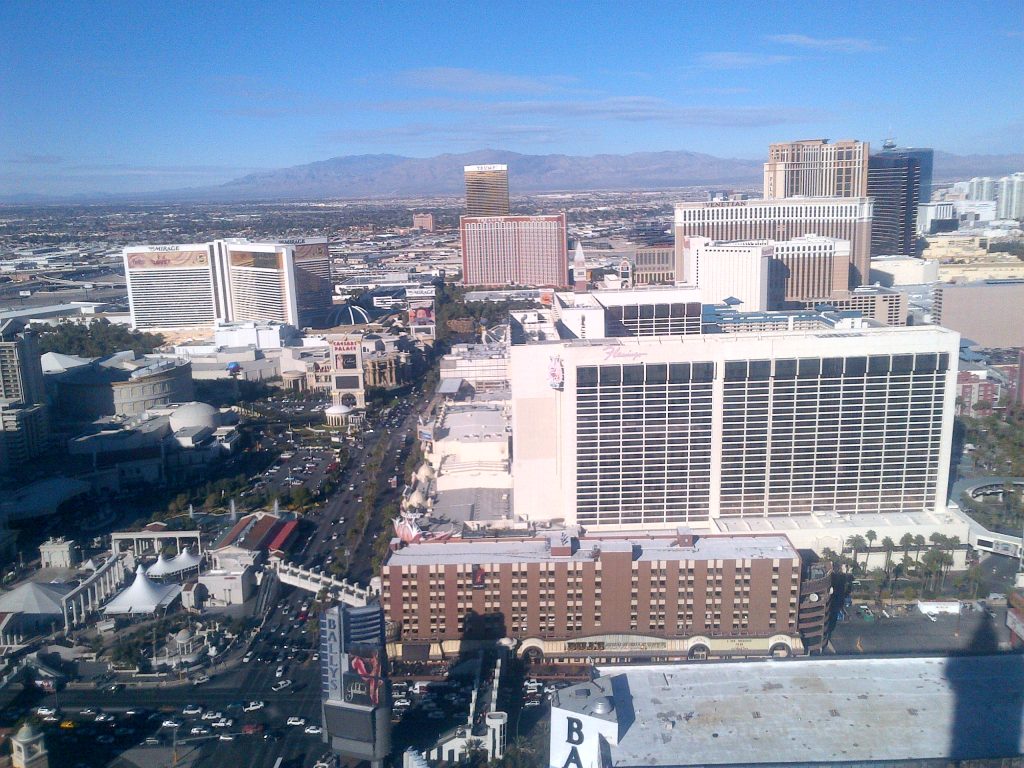
In 1829 a wagon train led by the Spanish merchant Antonio Armijo was traveling to Los Angeles to establish a trade route and took a rest break in what is now Southern Nevada. Since that time a regular stream of growth began in the area, slow at first, but then increasing to the point where the ecosystem is being taxed to support it. What happened to this small corner of rocky desert that made it such a popular place?
The Railroad Town in 1905: Owing to the proliferation of artesian wells in the area, the valley where Las Vegas now resides became famous as a rest stop for wagon trains, explorers, and eventually railroads. A small settlement appeared, and in 1905 the town was formally established by the State of Nevada and named Las Vegas, or The Meadows, for the greenery that grew around the wells. That same year the San Pedro, Los Angeles, and Salt Lake Railroad was completed connecting the valley to Southern California and the Port of San Pedro in one direction, and the Salt Lake area of Utah in the other. Soon afterward, another railroad was completed connecting the new railroad to the gold mines near Tonopah, Nevada, about 200 miles to the northwest. On May 15, 1905, 110 acres of prime land near the railroads were auctioned off, and the center point of what would become downtown Las Vegas was developed. The area further developed a growing economy based primarily on agriculture and trade until a series of adverse events forced it into a major dilemma. The Tonopah spur line declared bankruptcy and Union Pacific Railroad bought the remnants of the other line. A railroad strike in 1922 crippled the area’s economy and shut off what had been a strong twenty years of growth. The future looked bleak for all settlers and entrepreneurs that lived there.
Construction Workers’ Weekend Getaway: The dilemma that had gripped Las Vegas by 1922 went away quickly in 1930 when the Boulder Dam project was authorized by the Federal Government on the Colorado River not far away. A year later the construction of what would become Hoover Dam began, and the population of Las Vegas ballooned from about 5,000 or so to over 25,000 of mostly working aged men looking for construction jobs as the entire country was in the throes of the Great Depression. The government opted to build another town closer to the worksite to house the workers in spite of the effort to make the declining city of Las Vegas the home for the work force. But what do young male workers away from home do when they have some time off—drinking, gambling, and cavorting with women. In 1910 The State of Nevada became the last state in the West to outlaw gambling. But in 1931 the state recognized the plight of Las Vegas and moved to legalize gambling statewide in order to bring in legal gambling establishments to replace the existing illegal ones. Prohibition was still in force throughout the country, but enough bootleggers seized upon the opportunity to provide for the burgeoning marketplace. Dance halls opened up allowing the workers to meet local women. The dam was completed in 1937 bringing electricity in abundance to Las Vegas, and it was used to light up the city all over. But the gambling business got its greatest boost from a crackdown on illegal gambling that took place in Los Angeles in 1938. This sent a large number of gamblers up Highway 91 (later, Interstate 15) to the still growing Las Vegas and Clark County area, albeit largely on weekends and holidays.
The Tax Haven: Where does a growing industry go to find entrepreneurial and managerial talent when the industry is illegal in the remainder of the country? The answer would be in places where the industry exists, legal or otherwise. One such entrepreneur was Guy McAfee, a crooked L.A. police officer on the vice squad. He owned and operated gambling parlors, saloons, and brothels in Southern California until the 1938 crackdown drove him out and up to Las Vegas. He became the owner and operator of several clubs in Las Vegas in the 1940’s and early 1950’s, and also a significant real estate investor. He was credited with relabeling Las Vegas Boulevard as “The Strip” after Sunset Strip in Los Angeles. He also co-founded the unincorporated township of Paradise, Nevada, that became a tax shelter for casinos. McAfee also was the manager of the El Rancho that became the first real resort casino in Las Vegas. The importance of the El Rancho cannot be understated as it enabled tourists to have a place to come and enjoy a vacation aside from gambling. The success of El Rancho provided the blueprint of the modern-day casino that powers the Las Vegas economy.
The Rise of the Mob: Another source of casino entrepreneurial and managerial talent was the Mob. Beginning with Benjamin “Bugsy” Siegel, who developed the Flamingo in 1947, mob bosses could see the value of operating legally in Las Vegas versus operating underground in New York, Chicago, or any other major metropolitan area where gambling was illegal. There was another side benefit that the mob preferred and that was the concept of skimming the profits. A silent skim was typically siphoned off of the gaming profits and distributed to the mob boss owners without any record keeping of how much or where the skim took place. This was a further tax boost as revenue agents could not pinpoint the skims and their amounts. Mob bosses typically owned clubs in other metropolitan areas and consequently became acquainted with celebrities in the music and entertainment industry. Those connections brought ample amounts of entertainment talent to the growing number of casinos along “The Strip.” As the clientele was still predominantly working aged men, the entertainment often included lines of showgirls in skimpy outfits dancing with feathered fans and other burlesque-like performances. Acts with topless women appeared in 1957 giving the area the title of “sin city.” During WWII, the U.S. Army opened a gunnery school that later became Nellis Air Force Base to the northwest of Las Vegas. But Army commanders objected to having prostitution virtually legal in Las Vegas, so the government successfully applied pressure on the state to outlaw it, shutting down the “Red Light District” in the process. In 1971 the State of Nevada changed this law allowed brothels to be legally operated in individual rural counties with populations under 200,000. This omitted Clark County where Las Vegas is located, but nearby counties have permitted brothels, and prostitution itself exists in Las Vegas, although not legally.
Corporate Money Takes Over: As the area continued to grow, the people who owned the real estate were the ones positioned to gain the most. Selling real estate parcels near the strip became massively lucrative, and the proceeds were often parlayed by the owners into other real estate parcels where anticipated growth could take place. In 1967 The State of Nevada passed the Corporate Gaming Act that made it easier for corporations to own casinos. The big money of large corporations gradually pushed the relatively smaller money of mob bosses out of the way. At the same time the Las Vegas Valley area enjoyed a huge amount of growth becoming the fastest growing metropolitan area in the entire United States. This led to a major building industry to provide houses, commercial outlets, schools, and commercial properties away from the strip that supported the burgeoning population. In 1989 the Mirage opened on the strip with 3,044 rooms. This became the first of many mega-casinos that were built with investment money from Wall Street making average individuals part owners of the gambling riches. As the older hotels were smaller and required more maintenance, they became less profitable in their own business models. Over a period of perhaps thirty-five years up to the current times, many of these 1950’s and 1960’s vintage structures were torn out and replaced with even bigger and better resort-casinos. The city and county authorities went to great lengths to clean up the sin city image thereby encouraging families to come to vacation in Las Vegas where people of all ages could enjoy themselves. Gaming remained large, but was not the all-encompassing activity for vacationers. The casinos created arcade game rooms for younger people, miniature golf courses and water slides were built, great chefs opened fine restaurants all over the city, and the new hotels took on exotic and popular themes reinforced by their outward and inside architecture. Major fashion retailing appeared in many places along the Strip. The demand for more of a universal vacation experience became the driving force of the area’s future.
Conclusions: Las Vegas’s population in 2023 was estimated to be 651,000, whereas Clark County was estimated to be 2.29 million. The city now is host to the Raiders NFL team, the Golden Knights NHL team, and the Aces of the WNBA. There are several arenas available for basketball and hockey events, and Allegiant Stadium for football– an NCAA college bowl game is played there each year along with Raiders NFL schedule. Super Bowl LVIII was played in Allegiant Stadium February 11, 2024. The Oakland A’s of baseball’s American League have agreed to play in Las Vegas at a time in the future when a new stadium being built for them will be available.
Sources: History.com, How Los Angeles Became a Gambling Mecca, by Becky Little, May 13, 2022.
Wikipedia, History of Las Vegas.