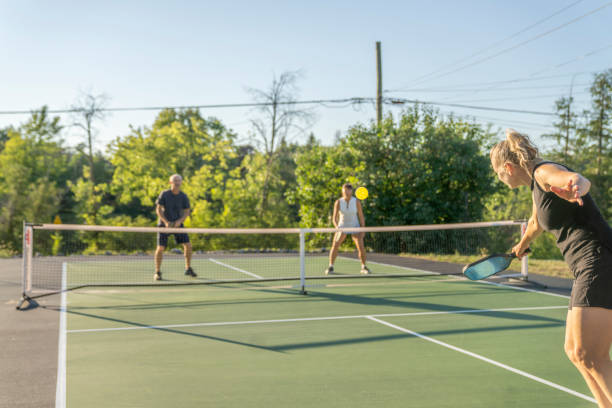
Have you ever played pickleball? It’s a game much like tennis although the court is smaller and the racket is replaced by a paddle resembling a table tennis paddle. The ball is lightweight, but can travel fast over a short distance like a whiffle ball. The rules and scoring are different, but the object of the game is roughly the same—hit the ball to the other side of the net. It’s a fun game for both adults and kids, but it’s more of a pastime for adults who enjoy a sport that is somewhat athletic but doesn’t involve a lot of running. From its inception to today its growth in popularity has been phenomenal. Here’s how it all came about.
Invention of Pickleball: One day in the summer of 1965, two businessmen had just completed a round of golf and were looking for something else to do. They decided to put together something made out of a hodge-podge of whatever they could find in the garage, and then challenged their kids to create their own game. They wound up with a badminton court, a whiffle ball, table tennis paddles, and a net they could set up to different heights. They set the makeshift court up in the backyard of Joel Pritchard’s summer home on Bainbridge Island, Washington, on the Puget Sound north of Seattle. After some experimenting with different paddles, nets, and dimensions of the court, the game of pickleball was created. Pritchard, along with Barney McCallum and Bill Bell are credited with putting together the equipment and establishing and documenting the rules during the summer months of 1965. The whiffle ball was replaced with the Cosom Fun Ball, a larger ball with perforations about the size of a tennis ball, and the table tennis paddles were replaced by larger wooden paddles designed and built by McCallum.
It is not clear where the name “Pickleball” came from. Was it Pritchard’s wife, Joan, who said that it reminded her of the “pickle boat” used in rowing where the crew is formed from the remaining available crew members not assigned to other boats. Or was the name given by Bell when he described the game as being enjoyable owing to certain strokes that could put the opponent in a pickle. Further, the Pritchard family dog’s name was “Pickles,” and a reporter used that as the game’s name believing that it would be easier for readers to remember; however, the dog was born after the name “pickleball” was established.
The first official pickleball court was built in 1967 at the home of Bob O’Brian, a friend of Pritchard’s. Its popularity grew with the families’ friends and neighbors. The next year Pritchard, and McCallum’s son David, along with two friends formed Pickle Ball Inc. to create a working body from which the game could be promoted. A few years later they trademarked the name Pickle-ball. The company then began to manufacture paddles and sell them along with balls, nets, and other paraphernalia that could be used to set up a pickleball court.
Early Growth: In the early years the sport’s popularity was limited to the Pacific Northwest and also Hawaii, where it was called “Pukaball” owing to the perforations in the ball. The promotional structure also picked up as the first official pickleball tournament was held in 1976 at the Southcenter Athletic Club in Tukwila, Washington, south of Seattle. A few years later in 1984, The United States Amateur Pickle Ball Association (USA Pickleball) was formed becoming the authority on everything that pertained to the sport. In the same year, USA Pickleball published an official rulebook, and organized their first pickleball tournament, the National Doubles Championships in Tacoma, Washington.
The sport was growing rather slowly and was still confined largely to the Pacific Northwest when it got a boost in 2001 from being a demonstration sport in the Arizona Senior Olympics drawing 100 participants. Five years later the number of participants for the same event grew to 275, and in 2008 pickleball was included in the United States Senior Olympics. It seemed destined to grow in states further south such as California, Arizona, and Florida, where outdoor recreation dominated lifestyles. The first USA Pickleball National Championship was held November, 2009, in Buckeye, Arizona, just west of Phoenix. The championships were moved around to various other locations and are continued to be held each year since 2009 (except for 2020 owing to Covid-19). In 2016 the inaugural U.S. Open Pickleball Championships were held at the East Naples Community Park in Naples, Florida, and have been held there every year since. In 2024 the April event involved 3,250 participants and drew over 50,000 spectators.
In 2019, Professional pickleball tournaments were formed, and the Association of Pickleball Players was created. Also, in 2019 the first stadium built exclusively for pickleball was opened in Fort Lauderdale, Florida. Named, The Fort, the facility includes 43 pickleball courts and a 4,000 square foot event center. The Fort is the permanent home of the Association of Pickleball Players. The Pickleball Hall of Fame was first established in 2017 by Seymore Rifkin, the founder of the International Pickleball Teaching Professional Association in 2015. Rifkin, an athletics enthusiast, road a bicycle across the country from San Diego, California, to St. Augustine, Florida, to raise money to build the Pickleball Hall of Fame. The IPTPA has grown to include instructors in 65 countries worldwide. However, in 2021, USA Pickleball created its own Hall of Fame, and after some negotiation, the two were merged in April, 2023.
The Covid-19 Boost: During the lockdown days of Covid-19 (approximately March to December, 2020) Pickleball was one of the few sports that qualified to continue playing in that the participants generally stood over six feet away from each other. The interest in the game swelled dramatically, and when the lockdowns ended, pickleball was well on its way to supplanting many other popular sports as a favorite pastime for adult players.
In 2024 the Sports and Fitness Industry Association release a report showing that the sport had grown over 223.5% over the three-year period ending in 2023, and that 13.6 million people played pickleball in 2023. Further, the Trust for Public Land reported that the number of pickleball courts in major cities grew by 650%, adding up to more than 3,000. The sport had spread coast to coast as the South Atlantic Region (from Delaware to Florida) had the most pickleball players with about 1.9 million—just ahead of the Pacific Region with about 1.5 million players. In July, 2023, the number of Apple Watch users that played pickleball exceeded those that played tennis. There’s even a pickleball T.V. streaming channel.
In 2022, pickleball reached the collegiate level with the first DUPR Collegiate National Championships. A year later the Association of Pickleball Players (APP) announced they would also begin holding college level pickleball championships with the APP U.S. Collegiate Championships. In March, 2022, the governor of the State of Washington signed the legislation making pickleball the state sport of Washington, while standing on the original pickleball court at Pritchard’s house where the game was invented.
A Look Inside the Pickleball Official Rule Book:
The rules are similar to tennis with some notable exceptions:
Each side scores only when serving, and the serving continues until a fault occurs. The first team to reach eleven points leading by at least two points wins the game.
There’s a two-bounce rule that requires each side to let the served ball bounce before returning it. For the remainder of the point, the bounce is not required.
A non-volley zone (known as the kitchen) exists on each side of the net directly in front and extending seven feet back from the net all the way across the court. Players cannot volley a ball in this zone.
Singles, doubles, and mixed doubles teams can play. If on a doubles team one partner loses the serve, the other partner takes the next serve.
A player position error (a player out of position according to the rules) may be called out by any other player.
Any player can stop the serve by raising either hand above the head or turning his/her back to the serving side.
Conclusions: In addition to the athletic side of pickleball, the social side has also risen and may have contributed significantly to the increase in the number of players. It is not uncommon to find groups of players getting to know each other on a public pickleball court and becoming friends that socialized together off the court. In one instance, a group of regular pickleball players in Southern California attended the wedding of one of the members… in San Miguel de Allende, Mexico! Although it is arguably less energetic than tennis, pickleball non-the-less provides substantial exercise for participants and still leaves enough time and energy for socializing.
Sources: Wikipedia, Pickleball.
usapickleball.org.