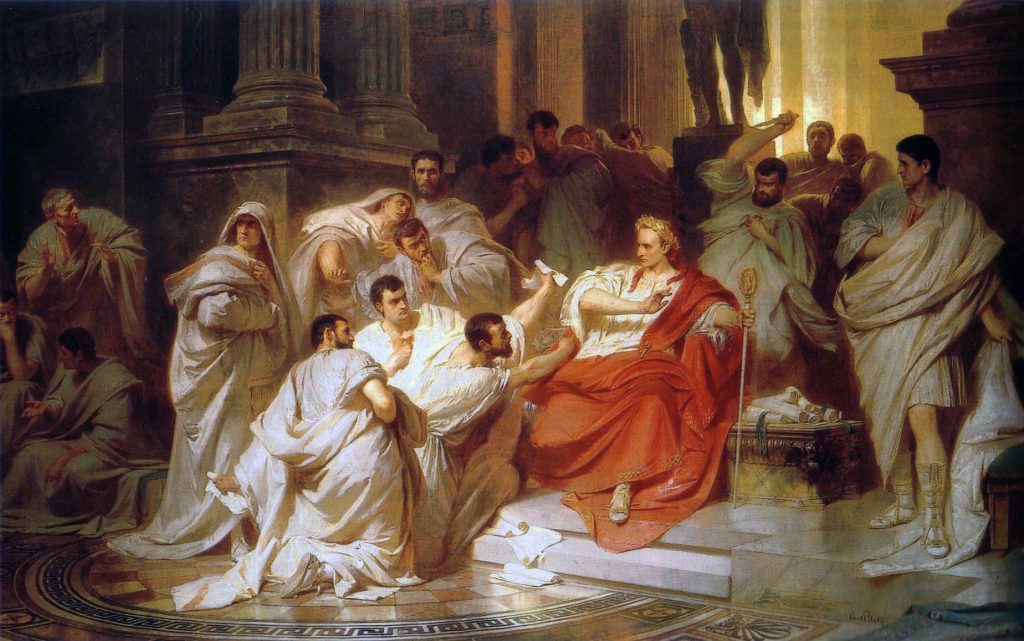
When Julius Caesar became Dictator for Life in Ancient Rome, it was a relatively short time before he was assassinated. His fate was sealed by someone he would never have thought of as an enemy—Marcus Junius Brutus. This raises the question as to whether Brutus was Caesar’s friend or his foe. To see how it came together we must first backtrack to Rome’s First Triumvirate.
Decline of the First Triumvirate: Prior to the rise of Caesar to the position of Dictator Perpetuo (Dictator for Life) Rome was ruled by a triumvirate of three powerful people: Gaius Julius Caesar, Gnaeus Pompsius Magnus (Pompey), and Marcus Licinius Crassus. The triumvirate was an unofficial agreement made largely by the three participants who agreed to share power by managing about one third of the empire from their various strongpoints: Pompey in Spain, Caesar in Gaul (France), and Crassus in Syria. In June, 53 BC, Crassus was killed along with most of his troops in the disastrous Battle of Carrhae in what is present day Harran, Turkey. Pompey and Caesar continued to rule jointly, but by 49 BC this relationship became frayed to the extent of an open rebellion breaking out. When the Roman Senate demanded that Caesar disband his army and return to Rome as a private citizen, this showed Caesar that Pompey had convinced the Senate to take Caesar out of politics altogether. Instead, Caesar marched his army across the Rubicon River in Northern Italy and sought out Pompey and his forces which were backed by the Senate making Caesar a rebel. But Caesar proved to be the better general and defeated Pompey at the Battle of Pharsalus on the 9th of August in 48 BC in central Greece. Pompey fled to Egypt where he was subsequently assassinated, and Caesar became Rome’s sole ruler. A few years later in 44 BC Caesar was awarded the position of Dictator Perpetuo or Dictator for Life.
Root Causes: With Caesar as sole dictator the civil war ended, but the concern about the longevity of the Republic became more desperate among numerous prominent Romans. The Roman Senate had backed Pompey in the Civil War only to see him lose and disappear. With Caesar now the winner, what actions would he take to limit the authority of the Senate and solidify his dictatorial powers? No official changes were set down, but Roman historians point to three separate incidents over a period of several months that may have enlightened certain senatorial conservatives to seek out action that would save the republic. The first one took place late in 45 BC (or early 44 BC) when the Senate voted to bestow certain honors on Caesar. To award the honors they had to march a delegation down to the newly constructed Temple of Venus Genetrix to greet Caesar with the honors. Caesar did not rise from his seat when the senators arrived providing a snub that violated protocol. Further, he made some sarcastic remark to the effect that his honors should be cut back rather than increased. This snub created the impression that Caesar as dictator had no use for the Senate. Then in early 44 BC, two tribunes discovered a diadem (an ornament headband signifying royalty) on the head of a statue of Caesar in the Forum. They promptly had it removed, but later Caesar was greeted by a crowd a few members of which referred to him as “rex” or king. The same tribunes were there and arrested the person who first used the word rex in front of Caesar. But Caesar later in the Senate accused the tribunes of attempting to create an opposition and had them both removed from office. However, the plebians did not appreciate the tribunes being removed, and the entire episode put Caesar on the wrong side of public opinion. Then at the festival of Lupercalia on February 15, 44 BC, Mark Antony, one of Caesar’s adjutants, placed a diadem on Caesar’s head only to have Caesar remove it and state that he was not a king. Again, Antony put the diadem on his head and again Caesar removed it, this time reserving it for a sacrifice to Jupiter and allegedly receiving a favorable response from the crowd. However, a growing number of patricians (landed gentry) began to see that the incident may have been Caesar’s way of testing the crowd to see if it would accept him as king.
Brutus the Lead Conspirator?: The conspiracy to assassinate Caesar began with a meeting between Marcus Junius Brutus and his brother-in-law, Gaius Cassius Longinus on February 22, 44 BC. It is not clear who the original instigator was, but it has been accepted that Cassius hated the dictator while Brutus hated the dictatorship. It is a paradox that Brutus would want to assassinate Caesar, who became his protector after Brutus joined Pompey’s forces in the civil war. During the battle of Pharsalus, a major victory for Caesar over Pompey, Brutus was captured, but spared by Caesar. Brutus managed to escape, but Caesar liked him well enough to exonerate him from siding with Pompey and granted him a post as the governor of Cisalpine, Gaul (the northern part of today’s Italy). He was further elevated to the position of praetor (a judicial magistrate) with Caesar’s help. This was considered to be the launching point to being promoted to consul, one of the most prestigious titles in Ancient Roman society. There is little in the way of evidence that points to why Brutus turned against his protector, but most historians of the time believe that Brutus was swayed by the opinion of the Roman elite that did not want to see the republic replaced by a dictatorship. Brutus and Cassius then began recruiting a host of other conspirators from many walks of life, including a group of other senators who also opposed a dictatorship. The total number of conspirators consisted of at least twenty and as many as sixty. It is interesting to note that this budding conspiracy was not the first to attempt to get rid of Caesar. The conspirators considered recruiting Mark Antony until one of their followers explained that Antony had turned down joining a conspiracy to kill Caesar the previous summer. The conspirators met in small groups to avoid detection, and used a network to notify the others of what would be transpiring and when. After much discussion it was decided to make the hit right before the Senate met on the Ides of March (March 15, 44 BC), as Caesar would be leaving on March 18 to conduct a military campaign in the east.
Ides of March, the Hit is Made: Caesar almost bypassed going to the Senate meeting as his wife told him of a nightmare she had with him covered in blood. He was later persuaded to attend by a general, Decimus Junius Brutus Albinus, one of the conspirators. The Senate met in the Theater of Pompey as an upgrade was being done to the Curia where they typically met. Caesar entered the theater alone as he was separated from Mark Antony by one of the conspirators. He was approached according to the plan by Lucius Tillius Cimber, a senator, who presented Caesar with a petition to recall Cimber’s exiled brother. Caesar’s attention being hijacked, the other conspirators gathered around and surrounded him. Caesar attempted to shoo them away, but Cimber grabbed Caesar’s toga and pulled in down baring his back, neck, and torso. A conspirator pulled a dagger making it clear that Caesar was about to be slain, but Caesar put up a fight to begin with. He fought off the first assassin only to be stabbed repeatedly by numerous others. The last stab was allegedly made by Brutus, provoking the saying “You, too, Brutus?” But this saying was made known by Shakespeare’s play, Julius Caesar in 1599. Two historians of the era believe without furnishing credibility that Caesar actually said, “You too, my child?” But owing to the swiftness of the attack and the anxiety on the part of the assailants, it’s quite possible that Caesar did not say anything, or if he did, no one picked up on it.
Aftermath: Although Brutus intended to address the Senate to explain why the assassination took place, the senators all fled the scene along with the conspirators during the confusion and commotion. The confusion spread to the streets in the Forum as the conspirators with blood-soaked clothes sought refuge on Capitoline Hill nearby. Mark Antony also fled the scene disguised as a plebian. Brutus and Cassius had hired a group of gladiators to provide protection for them. A day later General Marcus Aemilius Lepidus brought in troops to restore order around the Forum. Brutus was able to address a crowd in the Forum some time later. He presented his case for killing the dictator, and it was calmly received until someone loudly denounced Caesar starting an argument that led to a fight and another riot. Antony also began to take steps toward the top. He first met with Lepidus and some of Caesar’s supporters who likely encouraged the arrest and elimination of the conspirators, but Antony settled for reconciliation and he convened the Senate the next day. The Senate meeting settled with exonerating the conspirators for the sake of calm, but also retaining the decisions made by Caesar that would have been reversed if he were to be condemned as a tyrant. This was followed by a public reading of Caesar’s will and a public funeral. At the funeral Antony praised Caesar, then brandished the unwashed corpse showing the wounds dried up. He also presented a wax mannequin that displayed the wounds for better viewing. This all resulted with popular opinion turning against the conspirators obliging them to leave Rome for their own safety. Brutus and Cassius were able to muster forces of about 100,000 men enabling them to hold out for couple of years in Macedonia. But Antony was joined by Caesar’s appointed heir and grandnephew, Gaius Julius Caesar Octavianus. Along with Lepidus they formed the Second Triumvirate. In 42 BC Octavian and Antony joined forces to take down Brutus and Cassius, which they did after a series of battles obliging both conspirators to take their own lives.
The End of the Roman Republic: With the death of Brutus and Cassius the Roman Republic was on the ropes, but it wasn’t officially over until another civil war between Antony and Octavian took place over ten years later. This conflict proved decisive as Octavian defeated Antony’s forces in a naval battle near Actium, Greece. Antony had fallen in love with Cleopatra, Queen of Egypt, and intended to rule from Egypt. But as the forces of Octavian pressed their way from Syria down to Egypt in 30 BC, both Antony and Cleopatra committed suicide. Octavian replaced his name with “Augustus,” and ruled as Rome’s first emperor until his death by natural causes in 14 AD. His reign led to the consolidation of the Roman Empire under the Julio-Claudian dynasty, and was usually referred to as “Pax Romana” or Roman peace.
Conclusions: We may never know how Brutus felt inside when he turned against the man that saved him and helped him advance in Roman society. The earnest desire to save the Roman Republic certainly motivated him to take rash actions, but the impact of the actual deed may have made his life hard for him to live with.
Sources: National Geographic History, Vol.12 No.1, Brutus the Tyrant Killer by Pedro Angel Fernandez Vega.
Wikipedia, The Assassination of Julius Caesar.
ChapGPT.
Picture by Karl Theodor von Piloty, 1865.