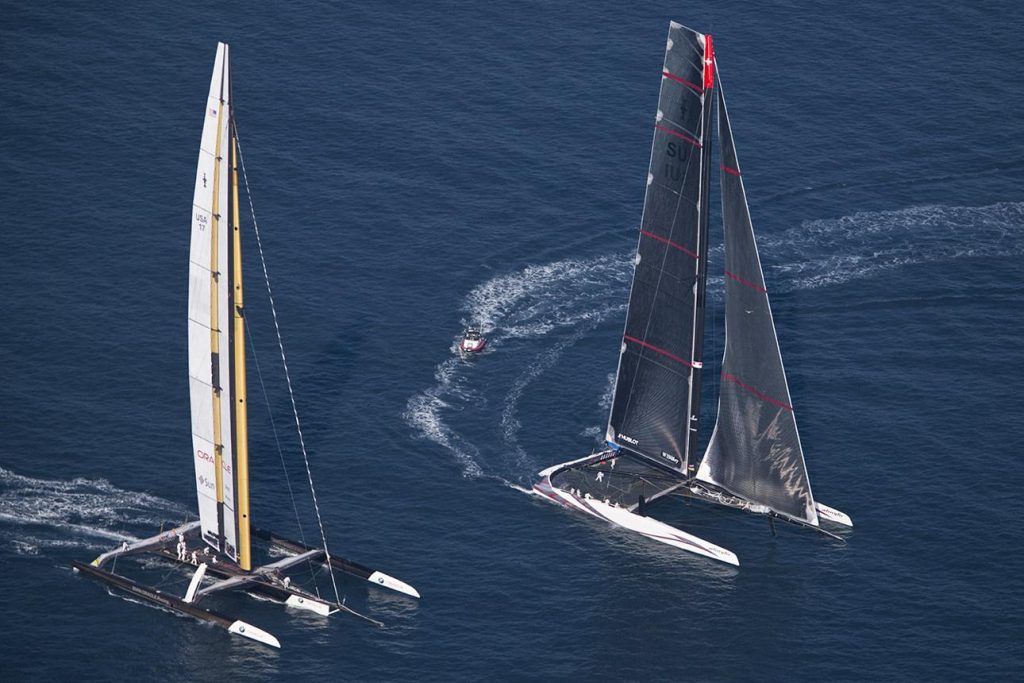
The oldest continuously operating international sporting event with the oldest international sporting trophy may not be the one most people think of. It’s not soccer’s World Cup, or the Olympics, or baseball, or cricket—it’s the America’s Cup of yacht racing. The origins of the America’s Cup date back to 1851, when a group of yachting enthusiasts at the New York Yacht Club had an idea. The sport is still thriving today. Here’s how it all came about.
The Beginnings: It all began when a charter member of the New York Yacht Club, John Cox Stevens, and some investors built a yacht with the intentions of sailing her to England to compete in regattas and match races. The result was the 101-foot schooner America designed by George Steers. She was launched on May 31, 1851, and set out to cross the Atlantic with Captain William H. Brown at the helm and a crew of twelve sailors. After some maintenance done in France, the yacht went up to Cowes on the Island of Wight and looked for a match race with British Yachtsmen. No matchup occurred, but on August 22, they joined fifteen British yachts of the Royal Yacht Squadron for a regatta around the fifty-three-mile circumference of the Isle of Wight with the prize being a two-foot-high silver jug crafted three years earlier and named the “RYS L100 Cup” (Royal Yacht Squadron one-hundred-pound sterling Cup). During the regatta the America came in first, twenty-two minutes or about two miles ahead of the next boat, the cutter Aurora. Ironically, the name of the cup was changed erroneously from “100 Pound Sterling” to “100 Guinea” when it was engraved (there was a slight difference in the stated value). The cup was brought back to the New York Yacht Club, but the yacht itself was sold to an Irish Nobleman. It then had an unremarkable future having been sold several more times, underwent at least two name changes, and served in the U.S. Civil War as a Confederate blockade runner, and later a Union blockade ship.
Deed of Gift of the America’s Cup: In the spirit of competition the title to the Cup was transferred to the New York Yacht Club via a Deed of Gift, a legal document that established the rules for further challenges as well as the conduct of the races themselves. The intent was for the Cup to be held in trust as the “challenge trophy” seeking the promotion of friendly competition among yachtsmen and developers around the world. In that the idea was new, the rules for challenging were fairly liberal at the time. But with the industrial revolution under way and boating technology improving, a lot of interest in yacht racing arose. Developers and boat captains read the rules and discovered various ways to bend them to suit their own interests. During each challenge, details such as the number of races, and the dimensions of the yachts were left by the Deed to be negotiated by the defender and the accepted challengers. But before long, the proprietors of the Deed (NYYC) saw the need to amend the agreement several times.
The 1881 Challenge: In 1881, for the fourth challenge to NYYC, the Canadian Bay of Quinte Yacht Club was accepted as the challenger. However, there were a few differences in the way the challenger Atalanta got to the event. The Quinte Yacht Club was located on Lake Ontario, and the challenge regatta required by the Deed was conducted there in fresh water and not the ocean. Further, the Atalanta was not sailed on its own bottom to the New York area but was delivered via the Erie Canal. This raised questions as to whether Atalanta was qualifiable as an “ocean-going yacht.” Further, the match itself was a rout with the defending boat Mischief winning the two race events by twenty-eight and thirty-eight minutes respectively, making the mismatched event bad publicity. But the rules permitted it, and when Atalanta’s captain/owner Alexander Cuthbert attempted to initiate another challenge, the guardians of the Deed decided to make some changes. The Deed was returned to the only surviving member of America’s original crew, George Schuyler, and he added language to require that the challenging yacht club hold its annual regatta on the sea or an “arm of the sea,” and the challenging yacht had to sail to the site of the match on her own bottom. Further language included that the challenger had to be constructed in the country it represented, the challenge had to be made by a properly organized foreign yacht club, and a defeated challenger had to wait at least two years to seek another challenge. These changes strengthened the rules for what had taken place, but did not prevent efforts by future yachtsmen to seek to gain advantage.
The 1887 Challenge: In 1887, the seventh challenge to NYYC, the Royal Clyde Yacht Club of Scotland was accepted as the challenger with Thistle against NYYC’s defender, Volunteer. The specifications of the challenging yacht sent with the formal challenge provided such technical information as the waterline length, an important aspect of a challenging yacht’s speed to the defender’s designers. When Volunteer was built, the designers relied upon those specifications to develop an equal match. Compliance with the rules appeared to be copacetic until Thistle was examined to its specifications by race officials before the event began. Thistle’s waterline length was set as eighty-five feet in their specs, but the length actually was 86.46 feet or nearly one and a half feet longer. As Volunteer was built under the pretense that the challenger’s submitted specifications were what the boat would be built to, the defenders were surprised to discover that the actual length was different and became suspicious of a deliberate attempt to deceive. However, the Deed did not provide for disqualification of a challenger under these circumstances. George Schuyler again entered the picture and resolved the dispute amicably by adjusting Volunteer’s time to make up for the difference in Thistle’s waterline length thereby precluding any charges of deliberate misrepresentation by the challenger. The issue turned out to be moot as Volunteer swept its way to victory, but the NYYC decided that the Deed needed to be changed again. The further changes were: the challenger’s notice was moved from seven months to ten months and the corresponding specs were to include much more information. Further, the challenging yacht club was required to have an annual regatta on an ocean water course.
Other Amendments: By the 1950’s yacht racing had changed making certain parts of the Deed impractical. George Schuyler died in 1890, thereby eliminating rewrites to the Deed and leaving amendments and interpretations largely to the courts. In December, 1956, the New York Supreme Court modified the Deed by reducing the minimum load waterline length to forty-four feet from sixty-five feet, and the requirement that the challenger had to travel on its own bottom to the event was eliminated. The waterline length reduction permitted the usage of the twelve-meter class yachts (the twelve-meter figure is the result of a formula of several specs on the yacht equaling twelve meters). Eliminating the travel requirement meant that challenging yachts could be shipped from as far away as Australia to compete in the NYYC’s home waters. Further minor resolutions involving construction details and nationality were added.
In 1983, the Cup was won by Australia II from the Royal Perth Yacht Club in Perth, Western Australia. This created a problem for scheduling the next challenge as the Deed stipulated that the racing must be done during the Northern Hemisphere’s racing season that specifically prohibits the months of November through April. The New York Supreme Court ruled on an application by the Royal Perth Yacht Club to amend the Deed to allow the next defense to take place in Australia during the Southern Hemisphere racing months.
The 1988 Challenge: In 1987, Stars & Stripes 87 captained by Dennis Connor from the San Diego Yacht Club in San Diego, California, defeated Kookaburra III from the Royal Perth Yacht Club, and brought the Cup to San Diego. In 1988, the challenge went to KZ-1 sponsored by Michael Fay and the Mercury Bay Boating Club in New Zealand. Rather than adapt to the recent court determined changes, Fay chose to stick to the exact wording of the original Deed and issued a challenge for KZ-1 with the length of a “single-masted yacht as 90 feet.” Fay’s strategy was to force the defender to build a yacht under the original document to match his leviathan rather than negotiate a more modern design using the 12-meter class. But Dennis Connor had a surprise of his own. Observing that the original document did not require the use of a monohulled vessel, he responded with a sixty-foot catamaran, Stars & Stripes 88. Knowing that the catamaran was much faster than his giant-sized monohull, Fay and the New Zealanders immediately objected. The issue went to court in New York with the judge ruling in July, 1988, that the Deed was not sufficiently clear on the subject for an injunction to be issued to block the race. Instead, the races went forward in San Diego with Stars & Stripes 88 winning easily. But the New Zealanders were not finished pursuing the matter in court arguing the matchup was not legitimate since the defender had a radically different design. This time the same judge agreed and disqualified Stars & Stripes 88, under guidance from the Deed that stated that the match had to be a “meaningful contest between reasonably comparable vessels.”
San Diego wasn’t about to give up. They appealed, and in a 4-1 decision in September, 1989, the appellate court reversed the original verdict saying that the Deed only says “any one yacht or vessel.” It does not require the yacht to be a monohull or comparable or similar to the challenging yacht. This brought the Cup, that had been held in custody of the courts, back to San Diego. But the New Zealander’s weren’t through yet, and they appealed to the highest court in N.Y. State, the New York Court of Appeals. There in a 5-2 ruling, the justices sustained the appellate court’s decision stating that Stars & Stripes 88 was in fact an eligible contestant under the 1887 Deed, and that San Diego had not breached its fiduciary obligations as the Cup’s trustee by racing a catamaran. In another interesting twist, the court as a remedy nullified the 1988 race results and gave San Diego the opportunity to conduct a new race. But at this point both sides declined a rematch and agreed to push on, with San Diego retaining the Cup for the next defense.
The 2010 Challenge: In 2010, another huge legal challenge was made over the rules presented by the Deed of Gift of 1887 as subsequently amended by the courts. The Cup was defended by Ernesto Bertarelli’s Alinghi 5 sponsored by the Societe Nautique de Geneve, versus the challenger, USA-17 sponsored by Golden Gate Yacht Club (GGYC) representing BMW Oracle Racing and Larry Ellison. The controversy began over the right to challenge as the Societe first granted that right to Nautico Espanol de Vela (CNEV). The problem was that CNEV was a new yacht club and had not conducted the requisite regatta on an ocean water course as required by the Deed. Ellison made a court challenge arguing that CNEV was not qualified, and that the only legitimate challenger was GGYC. The case proceeded all the way to the New York Court of Appeals which agreed with GGYC. The problem then shifted to the terms of the event as the two sides could not come up with a mutually acceptable agreement. This meant that the Deed’s nine default match rules would apply. As the rules were defaulted to the Deed, GGYC then specified the dimensions to be ninety feet on the waterline and ninety feet in the beam. The competing boats were a giant trimaran for GGYC and an equally giant catamaran for Societe, which turned out to be the fasted design that the Deed would allow in default. That being done were they finally ready race? Not yet.
GGYC wanted the racing dates to be in February, 2010, or ten months after the challenge was made as required by the Deed. Societe claimed that the Deed prohibited Northern Hemisphere races before the month of May. Both sides seemed correct as the Deed supported both premises. So, back to court they went with GGYC coming out the winner and the races scheduled for February, 2010. But the bickering was not over as GGYC charged that the Swiss yacht was not completely built in Switzerland as required by the Deed. Societe countered that Oracle’s yacht contained parts that were not made in America. Further, GGYC charged that Societe was abusing its rights as the trustee of the Cup to achieve unfair advantage. The bickering would go on for two years, but the races were held in February, 2010, in Valencia, Spain, with USA-17 winning 2-0. This default matchup as provided for by the Deed was enforced by the courts as closely as possible with what the Deed stipulated or what it specifically did not stipulate.
Conclusions: From the first challenge in 1870 to 1983, the Cup remained at the New York Yacht Club as twenty-four unsuccessful challenges ensued. Since then, the Cup has changed hands six times residing today in the trusteeship of the Royal New Zealand Yacht Squadron. The next challenge is underway, but the process has been changed to a playoff system. Beginning with six challengers, there is a round-robin tournament, elimination process, semifinals, and the Louis Vuitton Cup Final. The winner faces the current defender, Emirates Team New Zealand in July, 2027 for the America’s Cup.
Sources: History Channel, This Day in History, August 22, U.S. Wins First America’s Cup. History.com Editors, February 9, 2010.
Wikipedia, America’s Cup.
Wikipedia, Deed of Gift of the America’s Cup.
ChatGPT.