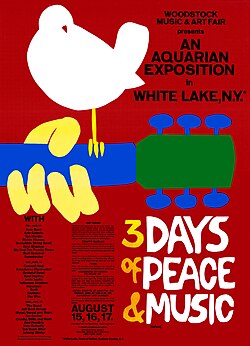
The year 1969 featured a nearly unique outdoor music festival name after a small town in New York State that was a haven for artists. It’s overwhelming popularity owing in large part to the collection of top recording artists of the day, brought out a massive crowd of spectators for the three-day event that overwhelmed the local logistics. The crowd behaved well by all standards in spite of the difficulties and appeared to be united in the Counterculture of the 1960’s. The name of the event will forever be known in history as the Woodstock Music and Art Fair. Here’s how it came about.
The Promoters: The project was organized by four entrepreneurs none older than age twenty-seven. John Roberts and Joel Rosenman arranged the financing, Michael Lang brought his experience with the 1968 Miami Pop Festival, and Artie Kornfeld was the vice-president of Capitol Records. Although based in New York City, Roberts and Rosenman were drawn to the town of Woodstock, N.Y., about fifty miles south of Albany, by Lang and Kornfeld who wanted to build a studio in the area that attracted a number of musical artists. Roberts and Rosenman countered this idea with having an outdoor festival featuring the same type of artists. With that in mind, the foursome formed Woodstock Ventures in January, 1969. They discovered that signing the big-name acts they had hoped for might never materialize until they signed Creedence Clearwater Revival in April, 1969. At that point interest rose in the festival, and thirty-one more groups signed on (see list below). Other notable artists from the era were contacted, but did not appear for one reason or another. Tickets went on sale in the Greater New York area with about 186,000 advance tickets sold. The organizers expected a crowd of about 50,000 to show up for each of the three days scheduled.
The Venue: The search for a suitable venue began in the town of Woodstock on a site owned by Alexander Tapooz, but that selection was quickly rebuffed by local residents who did not want the overflow crowds. Lang and Kornfeld then appeared to have another site lined up on the Winston Farm in nearby Saugerties, N.Y., but when Roberts and Rosenman talked to the landowner’s attorney, again they were rebuffed. As time was of the essence, Roberts and Rosenman took the venue task over and found another available site in Wallkill, about fifteen miles south and west of Poughkeepsie. They leased a 300-acre site in Mills Industrial Park after assuring the Town’s officials that the crowd would be no bigger than 50,000. The townspeople nonetheless objected and the Town Board passed a law requiring a permit for any event or gathering that exceeded 5,000 people. When the entrepreneurs asked for the permit, they found the restrictions that came with it to be excessive. So, in July of 1969, with just over one month before the opening act, the two entrepreneurs were still without a venue. Then an artist named Elliot Tiber in the town of Woodstock introduced them to a real estate agent who took them out to visit a dairy farm owned by Max Yasgur near the town of Bethel, N.Y., about 60 miles to the south and west. Yasgur’s son Sam was an assistant district attorney in Manhattan and acted as an advocate for the entrepreneurs with his father. After some discussion a lease was granted for the 600-acre property that had a bowl contour giving it a natural seating for viewing and listening. But the duo still needed permits for the event, and after meeting with some resistance from the townspeople they finally got the permits, but were running out of time. The construction foreman they hired explained to Rosenman that they could finish only one of two remaining tasks: build the stage, or finish building the fence and ticket booths. Choosing the rock over the hard spot, they went with the stage as the event couldn’t go on without it. Not having the fence and ticket booths insured that most of the attending public could walk in for free.
Three Days of Music: The promoters had planned on a crowd of about 50,000, but two days before the event began at least that number had already arrived and taken up positions. As the crowd swelled to about ten times what was anticipated, the infrastructure was soon overwhelmed. The roads in the area that led to the site were backlogged with traffic to the extent that many participants parked where they could and walked several miles or more to the site. An untold number of people planning to attend changed their minds and stayed away owing to the traffic conditions, or the crowd would have been even larger. The site’s facilities for food service, sanitation, and first aid were overwhelmed, and security was very light as the promoters had planned on hiring off duty NYC police but couldn’t as such activity would violate a police rule against moonlighting. Personnel from Stewart Air Force Base near the town of Newburgh were instrumental in keeping order and flying the performers in and out of the area via helicopter. The grounds were wet from recent rains, and the festival itself was interrupted by rain on occasion making a muddy surface for the audience. The management needed to improvise numerous times to ensure that the event could continue. The person hired for the stage lighting, E. H. Beresford “Chip” Monck, doubled as the event’s master of ceremonies, as Lang realized that he had overlooked hiring one. Owing to the number of artist’s participating, the acts were schedule to take place throughout the night into the early morning hours with a break that lasted until around noon. The order of appearance also had to be reinvented a few times as the performer’s had their own logistical issues getting to and from the site. In spite of all of the nuances, the crown generally enjoyed themselves and got along well with the elements and the overwhelmed facilities. Ample amounts of cannabis and hallucinatory recreation drugs likely went a long way towards mollifying the audience, along with the welling music. There were nonetheless two deaths: one from a drug overdose and one from a tractor accident. Additionally, there were eight women who reported having miscarriages, but most other injuries were drug related or involved cuts or scrapes to bare feet.
Media Coverage: Only the local press covered the event with a handful of reporters from major outlets also included. The Middletown, N.Y., Times Herald-Record had the only phone line out of the festival site, and had to shuttle photographs and stories by motorcycle bypassing the insufferable traffic some thirty-five miles to the paper’s office and newsroom. The major newspapers that did cover the event brought out the negative side emphasizing the serious traffic and logistic issues along with the rainy weather and the lack of fresh food and sanitation facilities. The New York Times covered the event from the Wallkill venue failure to Yasgur’s farm in Bethel. The reporter assigned to the story, Barnard Collier, complained that the editorial management of the Times wanted a very negative report on the event emphasizing the outcome as being disastrous owing to the conditions. Collier at first refused to write the story at all until the executive editor relented and decided to let him write the story as he saw fit. As a result, the Times story included the traffic and drug use, but went on to point out the co-operation and lack of violence on the part of the crowd. The chief medical officer along with several local residents were quoted as praising the young festival goers for their behavior. Max Yasgur himself also appeared on stage on the third day and spoke highly of the young crowd having “nothing but fun and music.”
Post Event Releases: The festival itself was a financial disaster for the promoters largely due to the failure to get the fences and ticket booths erected. But they still retained all the recording and film rights, and they soon went to work to get an album together and a feature-length documentary film. Kornfeld sought major backing for filming the event but was turned down by many film studios. When he went to Warner Brothers the management balked at the idea, but one executive, Fred Weintraub, stuck his neck out and gave Kornfeld a $100,000 advance. The promoters then hired Michael Wadleigh as the film’s director and Thelma Schoonmaker to head up the editing crew. Without funds to hire his own film crew, Wadleigh put together a staff on a “double or nothing” basis to make the film, meaning that if the project succeeded, the crew would be paid double the standard amount, but if the project failed, the crew would get nothing. The completed film was a major success and went a long way towards keeping Warner Brothers out of their rising bankruptcy issues. There were as many as six other feature-length films, shorts, and documentaries made of the event and its images. There were over a dozen different releases of the sound track in various shapes and forms.
Woodstock’s Legacy: The scene of the 1969 event has been preserved as a part of the Bethel Woods Center for the Arts, courtesy of Alan Gerry, a cable vision pioneer, who acquired the site in 1996. The center itself opened up in 2006 with the New York Philharmonic performing on a newly constructed stage a few hundred yards away from the original. Other groups have performed there since, and the Center hosted the 40th anniversary of the original event in August, 2009, with an eight-hour concert featuring several of the original artists. However, efforts by Kornfeld to organize a 50th anniversary event did not succeed. New York’s State Historic Preservation Office has applied to have the site listed on the National Register of Historic Places. The center has had over 4.5 million visitors since its opening, drawing 315,000 visitors in 2024 alone. It also employs 172 fulltime persons.
Artists Who Performed:
Richie Havens Grateful Dead
Sweetwater Creedance Clearwater Revival
Bert Sommer Janice Joplin with the Kozmic Blues Band
Tim Hardin Sly and the Family Stone
Ravi Shankar The Who
Melanie Jefferson Airplane
Arlo Guthrie Joe Cocker and the Grease Band
Joan Baez Country Joe and the Fish
Quill Ten Years After
Country Joe MacDonald The Band
Santana Johnny Winter
John Sebastian Blood Sweat & Tears
Keef Hartley Band Crosby, Stills, Nash, & Young
The Incredible String Band Paul Butterfield Blues Band
Canned Heat Sha Na Na
Mountain Jimmy Hendrix
Note that Country Joe MacDonald appeared twice: once in a fill-in solo performance capacity and once with his band the Fish.
Conclusions: Outdoor music festivals took place before Woodstock in 1969, and others have taken place since, but the combination of adverse logistics, weather, and massive numbers of attendees with very few security issues and major audience compliance stood out at Woodstock and was never replicated on that scale as successfully since then. The Woodstock Music and Art Fair became the peak musical event of the counterculture of the 1960’s that developed over the rising civil rights movement and resistance to the Vietnam War. It is still regarded as the epitome of outdoor concerts, and a pivotal moment in popular music history.
Sources: History.com, Woodstock, by the History.com Editors.
Wikipedia, Woodstock.
ChatGPT.
Image Courtesy of Arnold Skolnick.