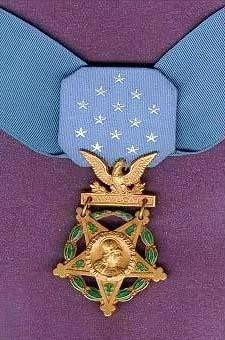
The Medal of Honor is the highest award in the United States given to a military member for bravery in combat against an enemy. Its issuance is authorized by Congress, but the recipient is determined by the branch of service in which the individual served. It was designed to represent bravery in battle, however, in its beginnings the medal was often awarded for meritorious service without regard to combat or war during the circumstances.
Beginnings: The Medal of Honor dates back to the beginning of the Civil War in 1861 when Army Lieutenant Colonel Edward D. Townsend, an assistant adjutant at the Department of War, made a proposal for a medal to be awarded specifically for valor in combat. His boss, Lieutenant General Winfield Scott, who commanded the U.S. Army at the time, opposed the idea and it went nowhere. Scott retired in October, 1861, but the Secretary of the Navy, Gideon Wells, liked the idea of medal for distinguished service and adopted it for the U.S. Navy. A bill was introduced in the Senate authorizing “200 Medals of Honor” to be given to sailors and marines “as shall most distinguish themselves by their gallantry in action and other seaman-like qualities during the present war…” It was signed into law by President Lincoln on December 21, 1861. Two months later the chairman of the Senate Committee on Military Affairs and the Militia, Senator Henry Wilson, sent a resolution through Congress to extend the concept of a battlefield decoration to include the Army. On July 12, 1862, this act was also passed. It wasn’t until March 3, 1863, that Congress expanded the army version to encompass soldiers of all ranks and stripes and made the medal permanent. In 1956, a separate version of the medal was authorized and designed for the U.S. Air Force, that became a separate branch of the military in 1947. A separate medal of honor for Coast Guard personnel was similarly authorized in 1963, but none were ever awarded. As of this writing there have been 3,555 Medals of Honor awarded all time from the first one in 1863. A total of nineteen service members received the award twice. Since the beginning only one female has been awarded the Medal of Honor—Dr. Mary Edwards Walker, a surgeon in the Union Army in 1861 who was captured in 1864, spending about four months as a prisoner of war. Sixty-one Medals of Honor were awarded to Canadians serving in the U.S. Armed Forces primarily during the Civil War. In eleven cases Medal of Honor recipients are directly related to other Medal of Honor recipients. Nine Medals of Honor have been issued to unknown recipients—four from the U.S., and five from other countries serving with the U.S.
Determination Criteria: The process of recommending the medal is usually managed through the chain of command of the appropriate branch. However, a recommendation may be referred to the appropriate branch via a member of Congress particularly if the serviceman is deceased. The medal is presented by the president on behalf of Congress, and therefore sometimes is erroneously referred to as the “Congressional Medal of Honor.” The president typically pins the medal on the awarded serviceman, or next of kin in the event the awarded individual is deceased.
The original criteria published in Navy regulations in 1865 stipulated that the Medal of Honor is to be awarded to “those petty officers, and others indicated, who shall have evinced in battle some signal act of valor or devotion to their country; and nothing save such conduct, coupled with good general qualities in the service, shall be held to establish a sufficient claim to it.” The first actual recipients were in the Army, however, and they went to six soldiers during the Civil War who clandestinely captured a Confederate train near Marietta, Georgia, and used it to attempt to burn bridges and other structures along the railroad back toward Chattanooga, Tennessee. Other medals during the war were awarded for “saving the flag” as this important act let combatants know which side occupied the area.
Medals were also awarded for gallant acts during peacetime such as saving a sailor from drowning or saving a civilian from a burning building. Between the World Wars, the Navy issued two versions of the medal: one for combat related valor, and the other for non-combat acts. During World War I, a host of medals that were awarded were subsequently recalled for failing the prerequisites. This led to an Act of Congress on July 9, 1918, that tightened the criteria for the recipient to “distinguish himself conspicuously by gallantry and intrepidity at the risk of his life above and beyond the call of duty,” and further the act must be performed “in action involving actual conflict with an enemy.”
In 1942, the Navy discontinued awarding non-combat related medals. The last non-combat medal was awarded in 1945, although the Navy attempted to award one later during the Korean war. On July 25, 1963, another law was passed that required the prerequisites for awarding the medal to be standardized throughout all branches of the military. The new law required that the act of gallantry must occur during one of the following circumstances:
1. While engaged in action against an enemy of the United States.
2. While engaged in military operations involving conflict with an opposing foreign force.
3. While serving with friendly foreign forces engaged in an armed conflict against an opposing armed force in which the United States is not a belligerent party.
President John F. Kennedy added the same criteria via executive order to the Purple Heart Medal, and similar requirements for the Bronze Star Medal. The Act plus executive orders enable the services to award the medals during cold war activities that were not officially declared as war per the U.S. Constitution, or the provisions of the United Nations Charter. As the requirements became stiffer, the adjudication process also became more thorough being reviewed from each branch’s decorations board all the way up to the assistant secretary for manpower and reserve affairs, the chief of staff of the particular branch, the secretary of the branch, the secretary of defense, and finally the president.
Revoked Awards: Before the law required the award to be for combat related bravery against an enemy, a number of medals were awarded for dubious other reasons. In 1916, the U.S. Army appointed a board consisting of five generals to review every Medal of Honor award made to date. The results were that 911 awards were made for reasons other than distinguished service. Among this number were 864 medals awarded to members of the 27th Maine Regiment simply for extending their service stints through the Battle of Gettysburg in late June, 1863. Also revoked were awards given to twenty-nine service members who were Abraham Lincoln’s funeral honor guard. Six medals awarded to civilians were revoked, but then restored later in 1977 and 1989. Although the revocation of the awards was reviewed by the Army’s Judge Advocate General, it was advised that the War Department should not attempt to have the medals returned or to take any punitive action against those individuals who continued to wear or display them.
Conclusions: Recipients of the Medal of Honor are held in the highest esteem by most individuals in the government and the military. The privileges also awarded are many in number and accompanied by certain courtesies commensurate with the status.
Sources: Wikipedia, Medal of Honor.
ChatGPT