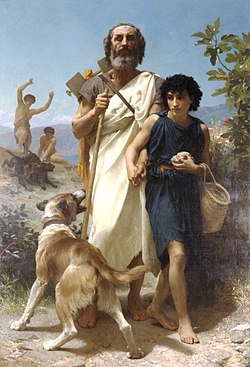
Homer, the ancient Greek poet, is praised as one of the first scholars in the history of Western culture. His major works, the Iliad and the Odyssey, were widely used in schools in ancient Greek and Hellenistic cultures and were often the first literary works taught to all students. They helped the later generations learn how their lives evolved from earlier generations. His wisdom was so respected he was thought of as a philosopher. But did he actually write the two major works attributed to him?
Did Homer Actually Live: Most of what antiquity tells us about the Homer’s existence came from a text entitled the Life of Homer written by an unknown author who claimed to be the early Greek historian Herodotus. The only problem with that is most scholars believe that Herodotus did not write it, and since the author did not take ownership of the text, it can be considered no more accurate than historical fiction. The text says he was born 168 years after the Trojan War that ended in 1184 BCE according to the Greek mathematician Eratosthenes, or in 1016 BCE. Modern archaeology uncovered evidence at the site of Troy showing that a major conflict took place between 1190-1180 BCE in which the city was burned and destroyed helping to establish Eratosthenes’ calculation, but not necessarily Homer’s birth. Herodotus did say that he believed that Homer probably preceded him by “no more than 400 years” (Herodotus lived about 484 to 425 BCE) thereby placing Homer’s life sometime in the 9th Century BCE. At least six different locations have been identified as his place of birth: Chios, Smyrna, Cyme, Argos, Pylos, or Athens. Some early writings indicate that he was blind and also a bard that recited (or sang) in the oral tradition about the Trojan War. Most accounts of his death place it in the island of Ios in the Aegean Sea between Naxos and Santorini. History has not been able to absolutely confirm that Homer was a living human being at one point in time, but it has forever attached his name to the famous early Greek poems, the Iliad and the Odyssey.
The Homeric Question: The uncertainty about Homer’s life and contribution to Western culture via the Iliad and the Odyssey has carried on for millenniums. Numerous scholars have pointed out one conflicting fact or another about Homer, the poems, the origin of the poems, and their true authorship, creating what has come to be known as the “Homeric Question.” Such subjects as the reliability of the oral tradition and the oldest elements in Homeric poems that can be dated with certainty are researched and sometimes debated by scholars as recently as the mid-twentieth century. Narrowing down the era during which the traditions were copied into text is also subject to considerable scrutiny. Although the Greek written language evolved in stages dating back as far as 1450 BCE, the Greek alphabet was adapted from the Phoenician alphabet circa 800 BCE. It continued refinement towards standardization until the Ionic version was officially adopted 403 BCE. The poems also followed a path of standardization taking place from the oral traditions to between 540-530 BCE when Peisistratus, Athens’ ruler at the time, ordered that the Iliad and the Odyssey were to be written in a “standardized” version. But the term “standardized” itself throws the door open for further debate. The following timelines can be used to represent the most likely transition of the poems to their written form: They were composed into oral tradition probably in the late 8th or early 7th century BCE in some collective form. They were written down probably in multiple versions and possibly in fragments from the 7th to the 6th centuries BCE. The texts became gradually stabilized over the 6th to the 4th centuries BCE through repeated performance, copying, and editorial work. Their most influential scholarly editions emerged courtesy of such scholars as Aristarchus of Samothrace at the Library of Alexandria from the 3rd to the 2nd centuries BCE. That would be roughly a thousand years after the Trojan War ended.
Oral Traditions: Owing to differences in the style of writing, most scholars believe that separate authors wrote the two poems. When looking at the length of each poem we find that the Iliad is about 250-350 pages and the Odyssey about 200-300. Together they add up to about 250,000-350,000 English words in translation from Greek (Please note that when Greek is translated to English, the number of words in a sentence can vary from source to destination). This would be a major load for any one qualified person in antiquity to transcribe both the poems based on oral traditions. When oral traditions are repeated, the person who hears the story usually applies what else he knows about the subject and combines that with what he heard to create his version of the story for future recitation. Each poem consisted of twenty-four books (think of them as chapters). How easy would it be to memorize and recite accurately two separate poems about 250 or 300 pages in length each. One thing that aided the oral tradition is that the poems relied upon repeating formulas, stock epithets, and set rhythmic structures known as dactylic hexameter. This formulaic composition aided the Greek bards in memorizing and retaining various parts of the poems, possibly fragments of a greater total, or simply a recantation of similar events such as other wars or fighting. The poems point to weapons used that were common in the Bronze Age that ended in about 1200 BCE—slightly before the Trojan War and its aftermath. It could be that some of the source of the oral tradition dated back even earlier to a different conflict. The likely path of the oral tradition began in the centuries preceding the time of Homer who probably lived in the ninth or eight century BCE. Gradually, the oral traditions grew in popularity and caught the attention of the scholars of the era who sought to “standardize” the poems into a uniform state. During this lengthy process (200-300 years or more) perhaps a bard by the name of Homer became instrumental, or was given credit for their creation that was not entirely due. Most of the early transcription probably did not take place until the Greek alphabet was updated to facilitate the written language. For several hundred years the early scripts were edited, modified, combined to the extent possible until complete texts emerged between 540 and 530 BCE. Homer is given credit for all of it. He certainly did not by himself complete the entire journey that the poems written in his name went through.
Conclusions: So, there’s very little that we know today about this man except that from antiquity forward he has been considered a pioneer of western culture with the two poems that have him as their creator: Iliad and Odyssey. It is not at all clear where he was born, but most scholars agree upon where he died thereby giving a large amount of credibility towards him having existed. He lived generally before the Greek Alphabet was updated to its more modern form, but could very well have had an element of leadership or participation in assembling the oral tradition. The first uniform complete texts appeared perhaps 300 years after his existence. His likely contribution was that he conveyed the oral tradition at a time when it became more and more popular prompting other bards and scholars to work towards transcribing and standardizing the works in his name. In antiquity there were several other works attributed to Homer, but today only the Iliad and Odyssey remain. In the final analysis we can look at him as a legendary figure who represented the entirety of early Greek poetry.
Sources:
Wikipedia, Homer.
Encyclopedia Britanica, Homer.
Gemini.
ChatGPT.
Picture: Homer and His Guide (1874) by William-Adolphe Bouguereau.