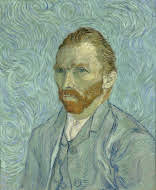
Vincent Van Gogh was arguably one of the most popular artists of the Post-Impressionist period in Europe during the 1880’s. He remains popular today as his style of intensity, broad brush strokes, and bold colors used to create over 2,000 works of art has not been matched. He painted 860 oil paintings, most of them in the last few years of his life, or on average better than one every two days. However, he suffered from some form of mental illness that he could not shake, and it contributed to his untimely demise. Here’s a sketch of his life:
The Early Days: Vincent Willem Van Gogh was born in Zundert, Netherlands, in 1853, into an upper-middle-class family that had a history of art trading. As a child he was quiet and serious, and took up art upon his mother’s encouragement. He was sent to boarding school twice, once in 1864 and again in 1866 to study art, but was unhappy with it. In his youth he had shown signs of mental instability and a lack of conformity to his scholastic or working environment. At age 16 in 1869 he went to work for an art auction house in Paris and a few years later he was transferred to the London branch where he became a modest success. In spite of this, he was dismissed from the organization for his failure to conform to their standards. He attempted several other vocations both near his home in the Netherlands and Britain, but was dismissed by his bosses or mentors as being unfit. On two occasions he fell in love with eligible women even proposing marriage, but was rebuffed both times. He went to study theology at the University of Amsterdam, but failed the admissions exam. He followed that up by studying to become a Protestant missionary, but flunked out after three months.
The Emerging Artist: In 1880, after a decade of failure and restlessness in his life his younger brother Theo, himself an art dealer, persuaded Van Gogh to pursue art in spite of his dislike of formal education. He went to Dutch artist Willem Roelofs who sent him to the Academe Royale des Beaux-Arts in Brussels where he spent a few months learning some of the basics. In the next few years, he went to visit a cousin, Anton Mauve, an established artist, who helped him get started painting with oils. Mauve had a falling out with him, however, and Van Gogh struggled on his own for a time until he decided to return to his parents’ home now in North Brabant, Netherlands, as his health deteriorated owing to his bad diet and drinking habits. Further, on two occasions he was treated for venereal diseases. During the next two years he painted nearly 200 oil paintings and numerous water colors and pastels. His work drew some interest, but Theo explained that his palette consisted mainly of earth tones and lacked the brighter colors that were popular during the Impressionist and Post-Impressionist periods.
Branching Out in Paris: In 1886 Van Gogh moved to Paris where Theo had an apartment. Vincent began painting portraits, still life pictures, scenes in Montmartre, and scenes along the Seine River. He began using brighter colors in his palette and his work began to draw more attention. He was exposed to other artists of the era and absorbed the culture. He also picked up on Pointillism, a style than consisted of painting a series of tiny dots that when viewed from a distance appeared as a solid color, along with Neo-Impressionism founded by Georges Seurat. He spent a few months working at Fernand Common’s studio and met other artists. But he appeared to be behind the curve of change, and had a falling out with Theo before moving to Asnieres, a northwestern suburb of Paris. He continued to work and mingled with other artists during exhibitions, especially one set up in a restaurant by Theo that was considered by some to be ahead of anything else in Paris. He painted over 200 paintings during his two years in Paris and felt worn out from all the effort.
The Great Productive Period in Arles: His relationship with Theo improved, and in February, 1888, he began the most productive period of his life in the town of Arles in Provence in the southern part of France. The contrast from the busy urban area of Paris pleased him as it gave him the feeling that he was in a foreign country. Being refreshed, he set out to paint the local countryside using yellow, deep blue, and purple colors, and during his time there he completed another 200 paintings and over 100 drawings and watercolors. In May, he leased four rooms in a house in Arles on the need of extra space for a gallery to display his work. He hoped to form an artists’ commune enabling artists to support themselves collectively. This idea advanced towards fruition when he was visited by Paul Gauguin whom he met in Paris. Gauguin moved into Van Gogh’s big yellow house on October 23, 1888, and the two collaborated briefly, but the harmony broke down and Gauguin opted to leave after two months. This dissolution hurt Van Gogh who was counting on some peer support only to find out that Gauguin was condescending towards him. Gauguin’s departure in late December, 1888, ties in some respect to Van Gogh’s losing control and cutting off part of his ear. What’s not clear is if in fact Van Gogh in a fit of rage went after Gauguin with an open razor. Van Gogh was later treated for his injured ear, but did not recall what happened fearing that he had a mental breakdown. He remained in the hospital until January 7, 1889, and was an outpatient for two months until he voluntarily entered the asylum at nearby Saint Remy where he remained for a year.
Return to Paris and Doctor Gachet: While in the asylum Van Gogh still managed to paint. His view was limited and therefore his scope, but using the garden and clinic as a studio he painted several of his most popular paintings including The Starry Night, and some interpretations of other artist’s work. The following spring he suffered a severe relapse and was unable to correspond with Theo. It didn’t stop his work, however, as he turned out several more paintings including Sorrowing Old Man (‘At Eternity’s Gate’). What he didn’t realize was that his work was beginning to attract attention at shows in other parts of the country. In May, 1890, he left the asylum in Saint Remy and moved to Auvers-Sur-Oise, a suburb of Paris, to be closer to Theo, and also to be treated by Dr. Paul Gachet. Gachet was an amateur painter himself, and had treated other artists of various psychoses. But Van Gogh continued to paint, including Portrait of Dr Gachet. In July, he wrote to Theo describing the nearby wheat fields that had captivated his imagination, by referring to them as representing his “sadness and extreme loneliness” and how they “…will tell you what I cannot say in words, that is, how healthy and invigorating I find the countryside.” On July 27, 1890, when only 37 years old, Van Gogh shot himself with a pistol and died two days later.
The Bernheim-Jeune Gallery March, 1901 Show: On March 15, 1901, Emil Bernard organized the first retrospective show of Van Gogh’s lifelong work at the Bernheim-Jeune Gallery in Paris. His style of dramatic, broad brushstrokes combined with brilliant, expressive colors drew a lot of attention throughout the art world. Although several smaller shows had taken place since his death, this first large, end-to-end, show of his work kicked off a series of other shows including Sonderbund in Cologne in 1912, the Armory Show in New York in 1913, and a show in Berlin in 1914. His popularity rose, but was not limited to just his art work. His many letters to Theo were preserved and published in 1914, reflecting an intelligent but intense artist who struggled throughout his life and died too early. An American novelist, Irving Stone, in 1934 wrote the novel, Lust for Life, using the letters as a base. In 1956, the novel was made into a film in Hollywood starring Kirk Douglas as Vincent. In 1971 composer Don McLean wrote a song entitled “Vincent” that’s also know by the first line “Starry, Starry, Night.” Van Gogh’s work today constitutes some of the most valuable art work in the world with several paintings valued at over $100 million, and many more at over $50 million. The Van Gogh Museum in Amsterdam opened in 1973. In 2024 the Netherlands government created the Van Gogh National Park in the southern province of North Brabant, in the area where he grew up.
Conclusions: It’s easy to see the great difficulty artists of the time encountered. Van Gogh had the support of his family and particularly his younger brother Theo, but throughout the course of his artistic career he sold only one painting—that’s right, just one. This could easily translate into failure to a struggling artist looking for some sign that his efforts are successful. He had trouble with interpersonal relationships, not only romantically with eligible females, but with those who would be friends and colleagues in his chosen vocation. His response was to paint, paint, and paint to exhaustion, nearly starving himself at one point to put as much resource as he could into art supplies. It became more intense for him as if quantity would be the solution to his life’s problems. It’s a sad irony that if he could have live twenty more years, he would have seen a world that welcomed and honored his work that became treasures to many, enabling him to reap the rewards that were due him.
Sources: History.com/editors, Van Gogh Paintings Shown in First Retrospective Exhibit, May 27, 2025.
Wikipedia, Vincent van Gogh.