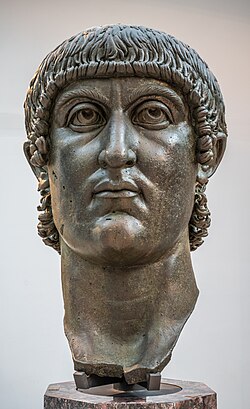
Of all the persons who followed Christ and promoted Christianity few had a more decisive impact than the Emperor Constantine who legalized the religion in the Roman Empire and helped bring the different tangents back to the same base. The boost given during his reign propelled Christianity to the forefront of Roman life, and later it became the state religion of Rome. As Rome began to decline, the Christian religion survived and later thrived, but this growth may not have happened if Constantine had not become emperor. Let’s take a look at how this all came about.
Diocletian and the Tetrarchy: To understand the rise of Constantine and Christianity we must first go back a few years to the reign of Diocletian, who ruled the Roman Empire from A.D. 284-305. When Diocletian became emperor, Rome was beset by a myriad of problems including civil wars and foreign forces fighting along the frontier. To restore order, he instituted the Tetrarchy that divided the empire in to two parts and installed a senior emperor and a junior emperor in each half. The responsibilities were also subdivided on the principle that governing the entire empire was becoming too complex for one person to manage. The Tetrarchy was implemented in 293 with Diocletian himself as emperor and Galerius as his second in command in the East, and Maximian and Constantius Chlorus in the West. Constantius Chlorus’s son, Constantine, went to live with Diocletian in Nicomedia (Izmit, Turkey) as a gesture to insure Constantius’s loyalty to Diocletian. It became more common for the emperors during this era to live outside of the city of Rome, usually in a place that was reasonably close to the fractious frontiers since most of them during this era had a military background. The tetrarchic system worked for a time during Diocletian’s life, but it didn’t last much longer after his abdication and death as the empire saw a return of civil wars.
The Last Christian Persecution: Christians living in the Roman Empire had been subjected to localized persecutions dating back to A.D. 64 when Emperor Nero blamed Christians in the City of Rome for the Great Fire. But there had been no law mandating a persecution that was applicable to all of Rome prior to the reign of Diocletian, who bit by bit began to change the status of Christians and other religious minorities, beginning with a purge of the military. Diocletian was willing to stop at this point, but in early A.D. 303 at the urging of Galerius, he began the most widespread and devasting persecution of Christians of all time. The four Tetrarchs issued a series of edicts that rescinded rights that applied to Christians in particular, and others that required that Christians comply with all traditional pagan religious practices. Further, property belonging to Christians was confiscated and structures including churches were torn down. Religious books were confiscated and burned. The Great Persecution, as it was called, was unevenly enforced, however, especially by Constantius Chlorus, whose approach to it was unenthusiastic. In other parts of the empire the persecution resulted in imprisonment, torture, and death, particularly of religious leaders, but the vast majority of Christians avoided severe punishment by simply complying with the practices of the imperial cult either overtly or tacitly. The persecution continued for over eight years, but it was doomed in 305 when Constantius Chlorus died of natural causes, and his army promoted Constantine to the position of emperor in the West. This usurpation was opposed by Galerius at first, but eventually endorsed as Galerius had become emperor in the East in the same year upon the abdication of the aging Diocletian. Galerius agreed only to allow Constantine to be the junior emperor, however. With his new position Constantine began to dismantle the persecution in the West with the advent of religious toleration and a promise of full restitution of losses.
An Edict of Toleration: It became apparent that the Great Persecution itself was beginning to die out. Not only did Constantine put a stop to it in his territory, but Maxentius, the son of Maximian who seized power in Rome in October, 306, brought toleration to Christians in his territory. That left Galerius as emperor of the only part of the empire that did not offer religious tolerance. Without accepting any responsibility for the persecution, Galerius issued the Edict of Serdica in 311 (also known as the Edict of Toleration). It was endorsed by three members of the Tetrarchy: Galerius, Constantine, and Licinius. This brought the Great Persecution to an official end, but did nothing to restore the confiscated properties, or make any recompense to those who suffered and the families of those who were killed.
The Battle of Milvian Bridge: Turmoil and civil war again impacted the Tetrarchy when Maxentius seized control of Rome. Galerius tried twice to unseat Maxentius, but both efforts failed. With a rival holding the main part of his territory, Constantine sensed an irreconcilable situation for his realm, and decided to align himself with Galerius. With the death of Galerius in 312, Constantine pulled out of his campaign against Germanic tribes and marched his forces into Italy to drive out Maxentius and unite all of the western empire under his control. After consulting with soothsayers Maxentius decided from ancient oracles that he had nothing to fear from Constantine, so he moved his forces outside the walls of Rome across the Milvian Bridge to confront Constantine. The bridge itself had been severed, but a hastily built pontoon bridge served as a replacement to move Maxentius’s troops across the Tiber River to the Via Flaminia. Constantine also sought an omen and had a vision of a cross-like symbol high in the sky that represented the Chi-Rho, the first two letters of Christ’s name in Greek. That night he had a dream that Christ commanded him to use the symbol in battle, and he had the symbol placed on his soldier’s shields and banners. After crossing the river, Maxentius found himself pinned against it when Constantine attacked. His forces were driven back onto the shaky pontoon bridge which collapsed causing a massive defeat and Maxentius’s death. Constantine credited the victory to the Christian God by way of the vision and the dream.
The Edict of Milan: Licinius, the number two emperor in the east, replaced Galerius upon the latter’s death in 312. Both Licinius and Constantine endorsed the principle “that it was proper that the Christians and all others should have liberty to follow that mode of religion which to each of them appeared best.” The Edict of Milan took the idea of religious freedom one step further than the previous Edict of Toleration. It effectively made the choice of religions up to each individual as all other religions were made legal as well. It wasn’t until 380 when another edict, the Edict of Thessalonica, made Christianity the state religion of Rome. But as of the Edict of Milan, the Christian Religion and all others became acceptable to the great relief of Christian religious leaders and all Christians throughout the empire. It further recognized the legal rights of Christians and ordered the restitution of Christian property seized during the persecution.
The Sole Roman Emperor: The Tetrarchy was now dissolved down to just two emperors: Constantine in the West, and Licinius in the East. Their rivalry continued for the next twelve years with political posturing and some civil warfare. Constantine got the best of the warfare and pushed his way further into Licinius’s territory. Then it became clear that Licinius did not fully support Christian rights as he agreed to per the Edict of Milan. It may have been that Licinius attached Christianity to Constantine who was actively promoting and supporting it while at the same time encroaching on Licinius’s territory. In any case, several more battles took place until the Battle of Chrysopolis in September, 324, where Licinius surrendered on the condition his life would be spared. It was, and he led a quiet life in Thessalonica until he was accused of plotting against Constantine in 325 and was hanged. It was at this point that the Tetrarchy was finished, and Constantine became the sole ruler of Rome. A couple months after the victory at Chrysopolis, Constantine revealed plans to build a new capital at the sight of Byzantium (Istanbul). He further began official Imperial Patronage of Christianity. This included, among others, the building of the Church of the Holy Sepulchre, and the Basilicas of St. John, of St. Peter, and of St. Paul. He brought religious leaders together to the First Council of Nicaea to sort out differences from one side of Christianity to the other. Six years later Constantinople appeared in a form of Rome’s image with the added presence of Christian buildings, churches, and other edifices. This provided the rising Christian Empire with a capital city that demonstrated Constantine’s appreciation for Christianity, and the apex of his contribution to its survival and growth.
Conclusions: It is unclear from known sources exactly what Constantine did see in his vision or his dream. But it’s safe to assume that whatever he saw impressed him that Christianity was behind him in his struggle with Maxentius. It further is not clear exactly when he converted to Christianity. He was baptized during his last days in a common ritual that would absolve him from all his sins enabling him to die in purity. He was deified by the Roman Senate as part of tradition, but was buried in the Imperial Mausoleum of the Church of the Holy Apostles in Constantinople.
Sources: National Geographic History, Vol 11 No. 5, November/December 2025, Constantine A Converted Emperor by Juan Pablo Sanchez.
Wikipedia, Constantine the Great and Christianity.
Wikipedia, Diocletian.
Great article Dave
Thank you for writing an extremely detailed article.